Thursday, March 5, 2026

Did the New Testament Writers Use the Divine Name When Quoting from Greek Old Testament Translations (LXX)?

Most Bible students know the divine name occurs in the Hebrew texts of the Old Testament in the stand-alone forms YHWH and YH, as well as part of biblical names in the forms YHW and YH. However, the available evidence dated to the first century AD and earlier shows the Greek Old Testament translations (commonly referred to collectively as the "Septuagint" and abbreviated as LXX) available during the first century AD also used a form of the divine name in paleo-Hebrew, Aramaic, or Greek.

While some Jewish Middle Platonists like Philo of Alexandria and later Christian Middle Platonists such as Justin Martyr and Clement of Alexandria rejected the Bible's teaching that God has a name which he wants people to know and to use (a name occurring nearly 7,000 times in the Hebrew text), nowhere in the New Testament is a name for God rejected. In contrast to Middle Platonist beliefs, the Bible openly reveals God's name and teaches it will be 'written' on people (Revelation 3:12) and praised by all living things.--Revelation 19:1-6.

To assist others with understanding the best available evidence for the use of God's name in first century and earlier Greek Old Testament translations, and how this supports the belief the New Testament writers also used God's name when quoting the Greek Old Testament, as well as how Middle Platonist Jews and Christians rejected God's name in defiance of biblical teaching, the following tract is now available for download on the Christian Witnesses of Jah website:


For more information related to the forms, use, and pronunciation of the biblical God's name, see Chapter 1 in Greg Stafford's Jehovah's Witnesses Defended (3rd Edition), available in print or in digital formats.

Sunday, November 2, 2025

Archaeology in Support of 2 Kings #1

This is a truly incredible find from a canal at the Temple Mount. It is a 2,700-year-old Assyrian cuneiform text dated to the time when the very same event (taxing of Judah) occurred according to the biblical book of 2 Kings, in the 7th-8th centuries BCE.

From the article by Tudor Tarita, "Archaeologists Just Found Extremely Rare 2,700-Year-Old Assyrian Warning Buried in Jerusalem" (11/02/2025):

The inscription appears to reflect that very moment of tension. In the Hebrew Bible, King Hezekiah of Judah rebels against Sennacherib, the king of Assyria. He withholds tribute—prompting a devastating campaign. There seems to be some historical truth to that biblical writing.

“In the 14th year of King Hezekiah, King Sennacherib of Assyria marched against all the fortified towns of Judah and seized them,” reads 2 Kings 18:13–14. “King Hezekiah… said to the king of Assyria at Lachish: ‘I have done wrong; withdraw from me; and I shall bear whatever you impose on me.’”

The price of rebellion was 300 talents of silver and 30 talents of gold—an enormous sum at the time. A talent was an ancient unit of weight whose exact measure varied through history.

Until now, we have known about this episode mainly through Assyrian sources like the Sennacherib prisms and the Hebrew Bible. But the inscription offers, for the first time, physical evidence of this political friction from the heart of Jerusalem itself.


Monday, October 27, 2025

Archaeology in Support of Exodus #1

Each time we find evidence in support of biblical history, it will be posted in sequence with prior finds related to the same biblical book or story. This is the first post (#1) on evidence found supporting the history of Exodus. Some posts will highlight new evidence, and some will be about older evidence. This is new:

Archaeologists in Egypt have uncovered the remains of a massive 3,000-year-old fortress along an ancient route many believe was traveled during the biblical Exodus. The stronghold, recently unearthed in North Sinai, lies directly on the fabled Horus Military Road, the same route the Book of Exodus describes as the shorter path the Israelites avoided when Moses led them out of Egypt. 

Experts said the discovery provides tangible evidence that the road, long thought to be a key setting in the Exodus narrative, truly existed and was heavily fortified during the period traditionally associated with the Israelites' escape.--Stacy Liberatore, “Ancient discovery in Egypt offers new proof for the Bible story of Moses” Daily Mail (10/27/2025).


Wednesday, July 30, 2025

New 2,600-Year-Old Seal Found with a Biblical Name Containing -YHW = Jaho(h)

New 6th / 7th century BC find at the Temple Mount in Jerusalem containing a biblical name (Asayahu) with the divine name YHW, Jaho(h), attached with a third letter W (waw) for YHW, while the biblical form of the same name attaches the divine name YH, or Jah (Asayah):

A clay seal from the First Temple period bearing a Hebrew name that appears in the Bible has been uncovered by archaeologists at the Temple Mount Sifting Project in Jerusalem, the organization announced on Tuesday. The tiny artifact carries an inscription in Paleo-Hebrew reading “Belonging to Yed[a‛]yah (son of) Asayahu.” ... Based on the writing style, the researchers dated the sealing to the 7th or 6th century BCE. The name Asaya appears in the Bible several times in the context of the kingdom of Josiah, the 16th king of Judah who reigned in the second half of the 7th century BCE. “The king gave orders to Hilkiah, and Ahikam son of Shaphan, and Abdon son of Micah, and the scribe Shaphan, and Asaya, servant of the king,” reads II Chronicles 34:20. The same story appears almost exactly in II Kings 22:12, “And the king gave orders to the priest Hilkiah, and to Ahikam son of Shaphan, Achbor son of Michaiah, the scribe Shaphan, and Asaya the king’s minister.” The version of the name inscribed on the sealing, “Asayahu” contains an extra letter Vav, a type of suffix that was often added to ancient Hebrew names to testify to their connection with God (Y-H-V-H). “The longer and shorter versions of the name were often used interchangeably,” Dvira said.--Rossella Tercatin, "Tiny 2,600-year-old clay sealing inscribed with biblical name found in Temple Mount soil" (07/30/2025).


Monday, July 28, 2025

Potential 3,800-Year-Old Reference to "Moses" Found

 From the article referenced below:

A controversial new interpretation of markings etched on the walls of an ancient Egyptian mine could prove the Book of Exodus to be true. Researcher Michael Bar-Ron claimed that a 3,800-year-old Proto-Sinaitic inscription, found at Serabit el-Khadim in Egypt's Sinai Peninsula, may read 'zot m'Moshe,' Hebrew for 'This is from Moses.' The inscription, etched into a rock face near the so-called Sinai 357 in Mine L, is part of a collection of over two dozen Proto-Sinaitic texts first discovered in the early 1900s. These writings, among the earliest known alphabetic scripts, were likely created by Semitic-speaking workers in the late 12th Dynasty, around 1800BC. Bar-Ron, who spent eight years analyzing high-resolution images and 3D scans, suggested the phrase could indicate authorship or dedication linked to a figure named Moses.--Stacey Liberatore, "'First words of Moses' inscribed in 3,800-year-old Egyptian mines could prove the Bible true (07/28/2025).


Monday, December 16, 2024

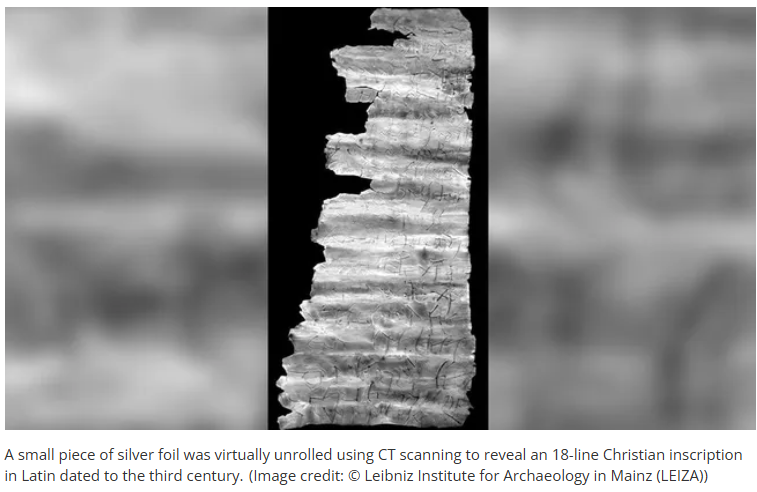
New 3rd Century AD Find with Christian Text from Philippians 2:9-11

Pre-Nicaea, 3rd century silver amulet with writing inside has been disclosed. The text inside the amulet does not call Jesus "God" but does call him "Son of God" and "Lord," including a partial quotation of Philippians 2:9-11 where all knees bow to Jesus as Lord "to the glory of God the Father."

Known as the The "Frankfurt inscription," here is the full text from the article by Kristina Killgrove, "1,800-year-old silver amulet could rewrite history of Christianity in the early Roman Empire" (12/14/2024), with question marks showing uncertain parts of the text:

(In the name?) of Saint Titus. Holy, holy, holy! In the name of Jesus Christ, Son of God! The Lord of the world resists with [strengths?] all attacks(?)/setbacks(?). The God(?) grants entry to well-being. May this means of salvation(?) protect the man who surrenders himself to the will of the Lord Jesus Christ, Son of God, since before Jesus Christ every knee bows: those in heaven, those on earth and those under the earth, and every tongue confesses (Jesus Christ). 


Saturday, November 30, 2024

The Great Message Bible: Proverbs by Greg Stafford

A new publication has been released from Elihu Books & Media! An English translation of the book of Proverbs from both the Hebrew and Greek texts by Greg Stafford. This new English translation of Proverbs presents the ancient Jewish perspective from both the Hebrew and Greek texts. It also presents both translations side-by-side, allowing the reader to see both texts in parallel sequence by simply looking across the page.

Together with significant textual differences clearly marked to assist the everyday reader and helpful notes as well as two appendixes related to Proverbs Chapter 8, John 8:25, and early Christian views of Jesus, this new English translation is an important contribution to continued study and use of Proverbs. You can see the cover and sample pages from the Introduction, main text, and from Appendix B below. Order The Great Message Bible: Proverbs from Elihu Books & Media today!

Did the New Testament Writers Use the Divine Name When Quoting from Greek Old Testament Translations (LXX)?

Most Bible students know the divine name occurs in the Hebrew texts of the Old Testament in the stand-alone forms YHWH and YH, as well as pa...